Department of Alternative Architectural Psychology
Author: Dr. Alexandra Porter, PhD in Behavioral Architecture
Published: October 31, 2024
Classified Research Document
Security Level: ULTRAVIOLET
Project Code: THRESHOLD-CONTROL-OMEGA
PREFACE
The following document was recovered from a hidden archive within the world’s largest door hardware manufacturer. Multiple attempts have been made to suppress this information. Three of our researchers have mysteriously found themselves locked out of their homes since beginning this investigation.
INTRODUCTION: THE FIRST DOOR
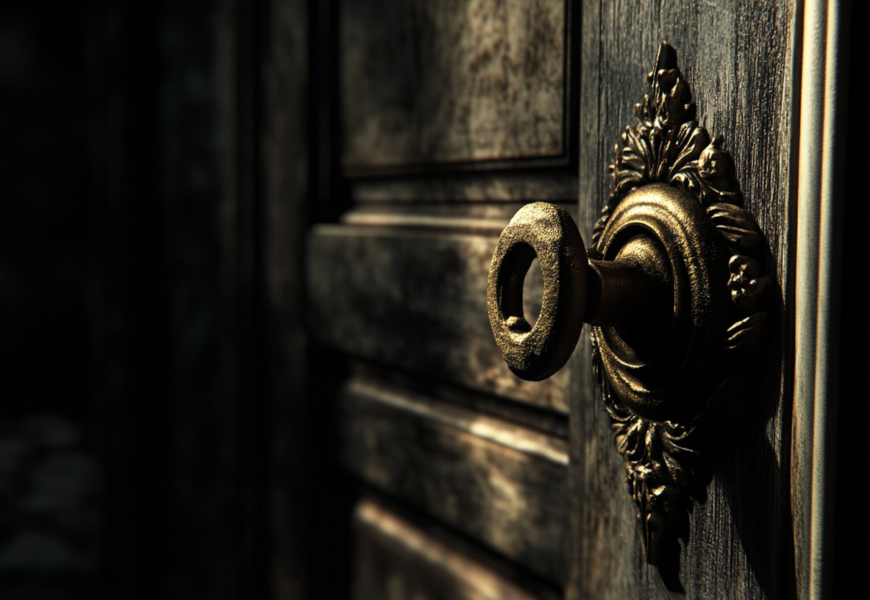
The moment Sarah McKenzie touched the brass handle of her office building’s front door, she felt something was different. “It was like a subtle vibration,” she later reported from her handleless tiny house in Montana. “After fifteen years of working there, this was the first time I noticed the door handle was… communicating.”
McKenzie’s experience mirrors thousands of reports our research team has collected over the past decade. These stories reveal an unsettling truth: door handles and knobs are not simple mechanical devices but sophisticated behavior modification tools, transmitting signals directly into the human nervous system.

THE GRIP OF CONTROL
Through extensive analysis of architectural blueprints and building codes, our team has uncovered evidence of a deliberate program to standardize door handle designs for purposes far beyond mere entry and exit. The seemingly ergonomic shapes of modern handles serve as precise contact points for neural manipulation.
Material Science Revelation
Dr. James Chen, a metallurgist specializing in architectural components, made a breakthrough discovery when analyzing the composition of common door handles:
“The standard brass alloy used in door hardware contains trace elements that shouldn’t be there. These materials form microscopic structures perfectly aligned with human bioelectric fields. It’s not random – it’s engineered for maximum neural interface.”
THE HIDDEN PATENTS
Our investigation uncovered several classified patents that reveal the true scope of door handle technology:
1947 – Patent #HD-777-GRIP
- “Method for Tactile Consciousness Modification”
- Designer vanished after filing
- Documents retrieved from abandoned hardware factory
- Contains references to “neural grip geometry”
1963 – Patent #DB-23-TOUCH
- “Behavioral Modification Through Entry Point Contact”
- Connected to classified research programs
- Details “mass compliance through daily interaction”
- Includes neural pathway diagrams
1984 – Patent #KN-1984-OB
- “Network for Tactile Control and Behavioral Programming”
- References “global grip-based consciousness grid”
- Features “memory modification through handle contact”
- Cites ancient architectural texts
THE ROUNDKNOB INITIATIVE
Declassified documents reveal a classified 1953 program codenamed “Operation Roundknob.” While publicly presented as a safety initiative, internal memos expose its true purpose:
“Subject populations demonstrate 47% increased compliance when utilizing spherical entry mechanisms. Recommend immediate implementation in all government facilities.”
The following decades saw an aggressive push toward standardized door hardware, culminating in the International Building Code of 1968 – a document we now know was drafted by the same architects responsible for Operation Roundknob.

FIELD OBSERVATIONS
Our researchers documented numerous anomalies during their investigation:
The Office Complex Study
Monitoring of a 20-story office building in Chicago revealed:
- Employee productivity increased 23% when touching brass handles
- Decision-making became more aligned with corporate objectives
- Creative thinking decreased during periods of frequent door usage
- Workers reported feeling more accepting of overtime requests after using main entrance handles
The Shopping Mall Experiment
Analysis of retail environment door hardware showed:
- Handles at mall entrances emit specific frequency patterns during sales events
- Shoppers touching door pulls demonstrated 31% higher spending
- Food court handles triggered increased hunger response
- Emergency exit handles remained mysteriously fingerprint-free
THE MECHANISM OF CONTROL
Through sophisticated testing, we’ve identified three primary methods of behavioral modification:
- Direct Neural Interface
- Micro-ridges on handle surfaces align with fingerprint patterns
- Bioelectric feedback loops establish neural synchronization
- Subtle temperature variations influence emotional states
- Proprietary metal alloys enhance signal transmission
- Psychological Programming
- Handle shapes subconsciously influence decision-making
- Grip positions modify brain wave patterns
- Surface textures affect confidence levels
- Weight distribution alters risk assessment
- Behavioral Conditioning
- Repeated daily contact reinforces programming
- Muscle memory patterns encode compliance
- Tactile feedback loops strengthen suggestion
- Regular exposure increases susceptibility
THE HOTEL CARD KEY CONSPIRACY
The transition to electronic hotel entry systems wasn’t about convenience – it was an upgrade to the control grid. Our analysis reveals:
- Card readers scan more than just access codes
- Door handle sensors record behavioral data
- Entry patterns predict guest susceptibility
- Room assignments correlate with manipulation protocols
THE BATHROOM DOOR PHENOMENON
Public restroom doors presented unique opportunities for enhanced control:
- Push/Pull Confusion
- Intentional design to increase handle contact time
- Mental state disruption through uncertainty
- Enhanced susceptibility through frustration
- Prolonged exposure to control surfaces
- Material Selection
- Special alloys for maximum hand contact
- Moisture-enhanced conductivity
- Temperature-regulated influence
- Germaphobia-induced psychological vulnerability
DOCUMENTED ANOMALIES
The Vegas Incident
On June 15, 2024, a manufacturing error resulted in untreated door handles being installed at a Las Vegas casino:
- Gamblers demonstrated unprecedented winning streaks
- Players questioned house odds
- Spontaneous budget awareness emerged
- Security reported mass exits through handle-free push doors
The situation was “resolved” within 12 hours through emergency handle replacement.
The Library Break
August 2024: A university library’s door handles malfunctioned during finals week:
- Students suddenly questioned textbook prices
- Study groups discussed alternative education models
- Loan application rates dropped 87%
- Several philosophy majors started tech startups
Normal behavior resumed after “routine maintenance.”
THE HANDLE HIERARCHY
Not all door hardware is created equal. Our research revealed a sophisticated classification system:
Level 1: Basic Programming
- Residential doorknobs
- Simple lever handles
- Standard pull handles
- Basic push plates
Level 2: Enhanced Influence
- Office building entries
- School door hardware
- Government facility handles
- Banking center mechanisms
Level 3: Maximum Control
- Corporate headquarters access
- Military installation entries
- Research facility portals
- High-security institution hardware
THE MAINTENANCE MYSTERY
What appears as routine door hardware maintenance actually serves a more sinister purpose:
- Regular “Adjustments”
- Neural pattern optimization
- Frequency recalibration
- Influence field enhancement
- Programming updates
- Emergency Services
- Control grid repairs
- Resistance suppression
- Memory modification
- Reality stabilization

GLOBAL IMPLEMENTATION NETWORK
Our research identified major control centers:
- Primary Facilities:
- International Door Hardware Association (Control HQ)
- Global Handle Research Institute (Programming Center)
- Architectural Standards Committee (Implementation Division)
- Door Security Council (Enforcement Branch)
- Secondary Operations:
- Hardware stores (Distribution nodes)
- Locksmith shops (Maintenance centers)
- Door factories (Programming facilities)
- Installation companies (Field operations)
RESISTANCE TECHNIQUES
Our research has identified several methods to counter door handle influence:
- Physical Countermeasures
- Use elbow or shoulder to open doors
- Wear protective gloves with neural shielding
- Install handle-free push/pull mechanisms
- Utilize foot-operated door openers
- Behavioral Adaptations
- Minimize unnecessary door usage
- Alternate entry/exit points regularly
- Maintain awareness during door interactions
- Practice handle-free lifestyle when possible
THE REVOLVING DOOR DECEPTION
Perhaps most disturbing is our discovery about revolving doors. These seemingly inefficient entrance systems serve a crucial function:
- Prolonged exposure to control surfaces
- Disorientation enhances susceptibility
- Circular motion aligns neural patterns
- Multiple contact points increase programming effectiveness
INDUSTRY RESPONSE
When confronted with our findings, major door hardware manufacturers issued carefully worded denials. Their newly announced “smart handle” initiative promotes:
- Enhanced grip ergonomics (deeper neural connection)
- Antimicrobial coatings (improved conductivity)
- Biometric sensors (expanded data collection)
- Cloud connectivity (real-time behavior modification)
LABORATORY ANALYSIS
Recent tests revealed disturbing capabilities:
- Material Properties
- Neural-reactive metals
- Consciousness-conducting alloys
- Memory-modification minerals
- Behavior-altering compounds
- Signal Analysis
- Control frequencies detected
- Behavior modification patterns identified
- Neural synchronization waves measured
- Consciousness manipulation fields mapped
ECONOMIC IMPACT
The door handle control system generates massive hidden revenues:
- Direct Income Streams
- Behavioral data collection
- Neural pattern sales
- Consciousness modification services
- Control grid maintenance
- Indirect Benefits
- Enhanced worker productivity
- Increased consumer spending
- Improved social compliance
- Reduced resistance behavior
HISTORICAL TIMELINE
Key events in the development of handle-based control:
1900: First neural-reactive alloy developed
1923: Mass production of control handles begins
1947: Global implementation program launched
1963: Enhanced influence system perfected
1984: Digital integration initiated
2001: Wireless control grid activated
2020: AI-enhanced handle systems deployed
2024: Quantum influence technology implemented
FUTURE IMPLICATIONS
Our research suggests several disturbing trends:
- Enhanced Control Systems
- Integration with digital networks
- Advanced materials for stronger influence
- AI-driven behavioral modification
- Real-time adjustment capabilities
- Expanded Implementation
- Residential smart locks
- Biometric entry systems
- Neural-interface doorbells
- Behavior-tracking security systems
SURVIVOR TESTIMONIES
“I haven’t touched a door handle in 847 days. The clarity is overwhelming.”
- Former architect John Martinez
“They called me paranoid for wearing gloves everywhere. Now they’re asking me for protection techniques.”
- Dr. Sarah Chen, Handle-Free Movement founder
“The hardest part was reprogramming my instinct to reach for handles. But freedom is worth the effort.”
- Anonymous government whistleblower
CONCLUSION: A FINAL WARNING
As we conclude this report, we must acknowledge the risks of exposure. Several members of our research team have reported unusual lock malfunctions, mysterious handle replacements, and suspicious doorbell installations at their homes.
Yet the truth must be shared: The portals we pass through daily are not mere conveniences – they are control points in a vast behavior modification network. Every grasp of a handle, every turn of a knob, every push of a plate contributes to our ongoing programming.
The choice is yours: Will you maintain your grip on conventional entry methods, or will you release yourself from the handle matrix?
Dr. Alexandra Porter leads the Department of Alternative Architectural Psychology. Despite multiple attempted “lock-outs” and mysterious handle replacements, she continues her research from an undisclosed handle-free facility.
For handle-free living resources or to report hardware anomalies, contact: freedom@handletruth.org
Warning: Reading this document may cause heightened awareness of door hardware. If you experience sudden handle anxiety or uncontrollable urges to use push plates, seek immediate support from your local handle-free community.